Every explored choice in an infinite story carries two small numbers: an eye with a percentage and binoculars with a pair like 4/3. Together they tell you where readers went at each fork and how much story waits down each path. Story pages add view counts on top.The reading guide introduces these stats in passing. This page goes deeper: what exactly each number measures, how to use them as a reader, and what they reveal to you as a writer about where your audience goes and where it stops.
Under a chapter, every choice that already has a continuation shows its stats in one small line: the eye percentage, the binoculars pair and, once votes exist, the member and guest ratings of the chapter behind it. A choice nobody generated yet shows no stats line, because there is nothing to count. Its Continue this path button marks it instead.One fork, two paths: 89% of readers went left, but the right path runs deeper (5/3 vs 4/3).
The two icons answer different questions. The eye is about the past: where did readers go? The binoculars are about the future: how much is there to read?
The eye: share of readers at this fork
The eye percentage is the share of readers among all sibling choices at this fork. 89% means that of everyone who picked a path here, 89 in 100 went this way. The percentages of all explored siblings add up to the whole, so a lopsided pair like 89%/11% marks a heavily beaten path next to a rarely taken one.Hover the eye for the absolute number behind the share.The percentage is deliberately the headline number, since 89% reads the same on a story with 20 readers as on one with 20,000. Hover the eye and the tooltip reveals the absolute count. One special case: on crossover continuations there are no sibling choices to share with, so the stat shows the plain view count instead of a percentage.
The binoculars: how much lies ahead
The binoculars show two numbers, readable chapters / longest remaining path. A 4/3 means four chapters exist somewhere down this choice, and the longest unbroken line of them continues three chapters from here. The first number measures how bushy the subtree is, the second how deep it goes.The tooltip spells it out: chapters down this choice, and how far the longest path continues.Compare the two paths in the screenshots: the popular 89% path holds 4 chapters, while the neglected 11% path actually holds 5. Popularity and depth are independent, which is exactly why both numbers exist. A reader hunting the longest read should follow the binoculars, ignoring the crowd.
Views on chapters and stories
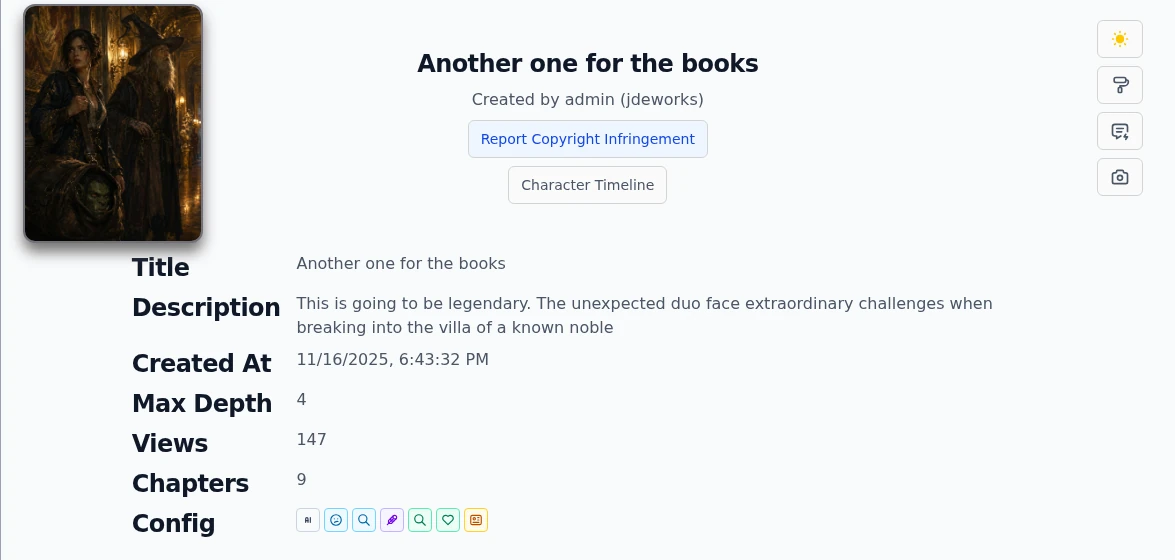
The story page carries the bigger picture. Open the collapsed Story details block on the overview page, and the details grid there lists total Views, the number of Chapters and Max Depth, the longest chain from the first chapter to any leaf. Each chapter card additionally shows its own absolute view count next to an eye in its header.Story-level stats: views, chapters and max depth at a glance.
All view counts exclude the creator's own reads. You can reread your story a hundred times while writing without inflating anything, and a view count of 40 really means 40 reads by other people.
What the stats tell a writer
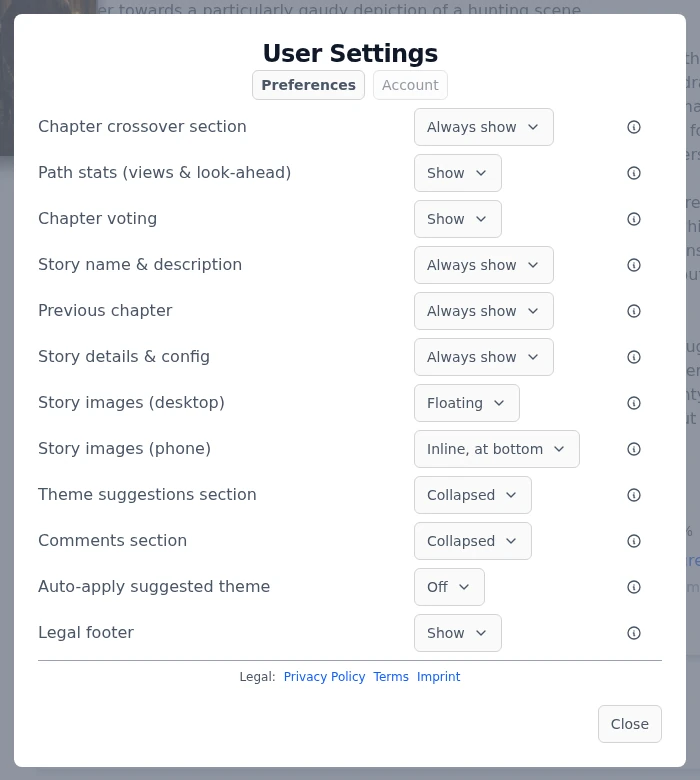
For the writer of a branching story, these numbers are a map of audience behavior. A fork where one choice takes nearly all readers tells you which choice text pulls, and that is worth studying when you word the next fork. A path with a high eye share but small binoculars is demand without supply: readers keep choosing it and then run out of story. Generating continuations there first is the highest-impact writing you can do.Dead ends with a real view share are the same signal in its strongest form. The Story Finder 's chapter panel even has a Dead ends filter to list them for any story, including yours.If the numbers distract you while reading, both parts can be switched off in User Settings on the Reading tab: Path stats hides the eye and binoculars, Chapter voting hides the thumbs and rating scores. The settings dialog requires an account, and the choice only affects the device you set it on. See basic settings for the rest of that dialog.Two per-device switches: path stats and chapter voting, both on the User Settings Reading tab.
Best practices
Hunting the longest read? Follow the binoculars' second number and ignore the eye. The crowd's route is often just the first-listed choice.
As a writer, sort your effort by demand: continue high-eye, low-binocular paths before starting new branches nobody has asked for.
Treat a 90/10 fork as feedback on your choice wording. The neglected arm usually promises less in its one line, and readers can only judge the label.
Check your story's dead ends now and then via the Story Finder's Dead ends filter. A dead end with views is an invitation to keep writing.
Signed in, hiding path stats applies everywhere you read. Signed out, each browser keeps its own answer, so a shared computer stays unaffected.
Under the hood
Each chapter ships a per-choice stats map alongside its choices, holding views, subtree size, subtree max depth and the vote tallies for the chapter behind that choice. No extra request is made for the stats line.The eye percentage is this choice's views divided by the summed views of all sibling choices at the fork, rounded. The absolute count lives in the tooltip. Crossover continuations have no siblings, so they show the absolute count directly.The binoculars' second number is the subtree's maximum depth minus the current chapter's depth, floored at 1. The first number is the total chapter count in that subtree.View counts exclude the creator's own reads everywhere: on choices, in chapter headers and in the story details block.Signed in, the path stats and chapter voting switches follow your account onto every device. Signed out, they stay in that browser. Both default to visible, and hiding them changes nothing about the story or its counters.Vote scores next to a choice split members and guests into two separate tallies, and a tally with zero votes is hidden entirely instead of shown as a dash.