Infinite Stories hosts what its writers publish, so the copyright rules are simple to state: publish what is yours, or what is genuinely free for everyone. This page explains both sides of that deal, the public-domain classics that ship with the library, and the formal path for reporting a story that copies protected work.The binding texts are the Terms and Copyright pages linked in the footer of every screen. This guide is the plain-language tour.
Everything you generate and write in the app is yours to publish. Pasting someone else's protected text into a story is never allowed, whatever the visibility. Translations of protected works count too, since a translation carries its own copyright.Fan fiction, meaning new stories with someone else's protected characters or world, has its own path. Share it through a fan-fiction group. That marks the story as fan fiction: it keeps the visibility you choose, only logged-in readers can see it, and its continuation lock starts switched on so nobody else can continue it unless you invite them. Rights holders can have fan fiction taken down at any time. Some authors have asked fan-fiction sites not to host stories based on their books, and the app warns you when your source is one of them. See Groups .Public domain is the big exception: works whose protection has expired belong to everyone. As a German-run platform, Infinite Stories applies the European rule of thumb, author dead for at least 70 years. A work being free in one country does not make it free everywhere, so when in doubt, check before you publish.
This page is help content, not legal advice. For anything binding, read the Copyright and Terms pages in the footer, and talk to a professional if real money or real risk is involved.
The public-domain classics in the library
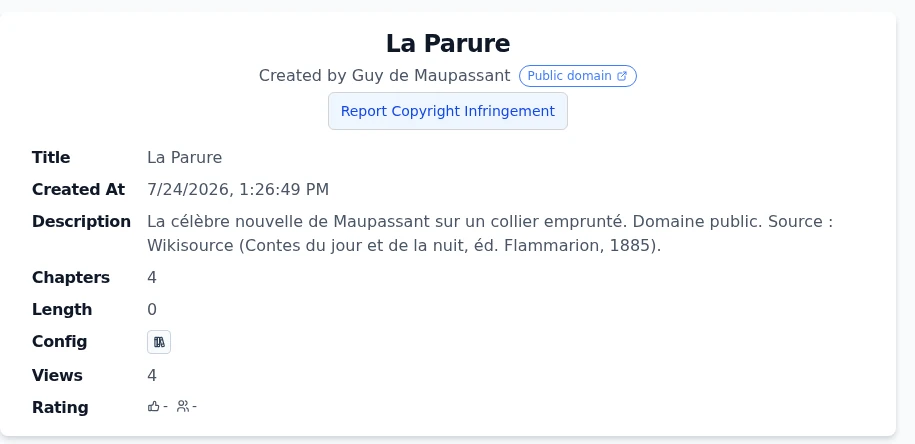
The library ships with a shelf of classics: Poe, Maupassant, Chekhov, O. Henry, Twain, the Brothers Grimm, Kafka, Doyle and more, imported as short stories under accounts named after their real authors. Some are English, some original-language, like La Parure in French or Vor dem Gesetz in German. The language filter finds them.A seeded classic: author as creator, a Public domain chip, and the source recorded in the description.You can recognize these stories by two markers. A Public domain chip sits next to the creator name and links to the author's Wikipedia page. The story description names the source edition, for example a Wikisource or Project Gutenberg text. That provenance line is the attribution, and it stays with the story.The classics carry genre, tone, theme and reading-level classifications like any other story, so the Story Finder reaches them. Filter by Horror and both Poe stories come back; filter by Crime & Mystery and Sherlock Holmes is there. Clicking a badge on one of their rows searches for more of the same.
Reporting a copyright infringement
If a story copies work you own, use the Report Copyright Infringement button. It sits near the top of every story page, and the same button exists on shared characters and scenes from the Character Builder and Scene Builder .The report button on a story page. Characters and scenes have the same one.
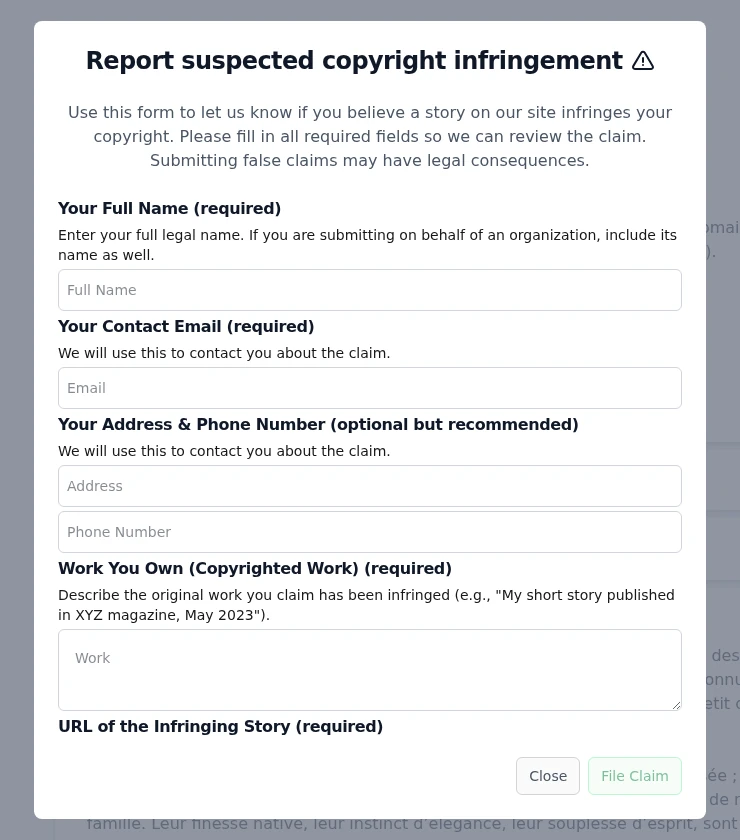
Click Report Copyright Infringement. The claim form opens with the story's URL pre-filled.
Enter your full legal name and a contact email. Address and phone are optional but help.
Describe the work you own and how the story infringes it. Concrete details carry the claim.
Confirm the good-faith and accuracy statements. The second one is made under penalty of perjury.
Hit File Claim. You get a confirmation, and the team follows up by email.
The claim form. Every required field protects both sides of the dispute.
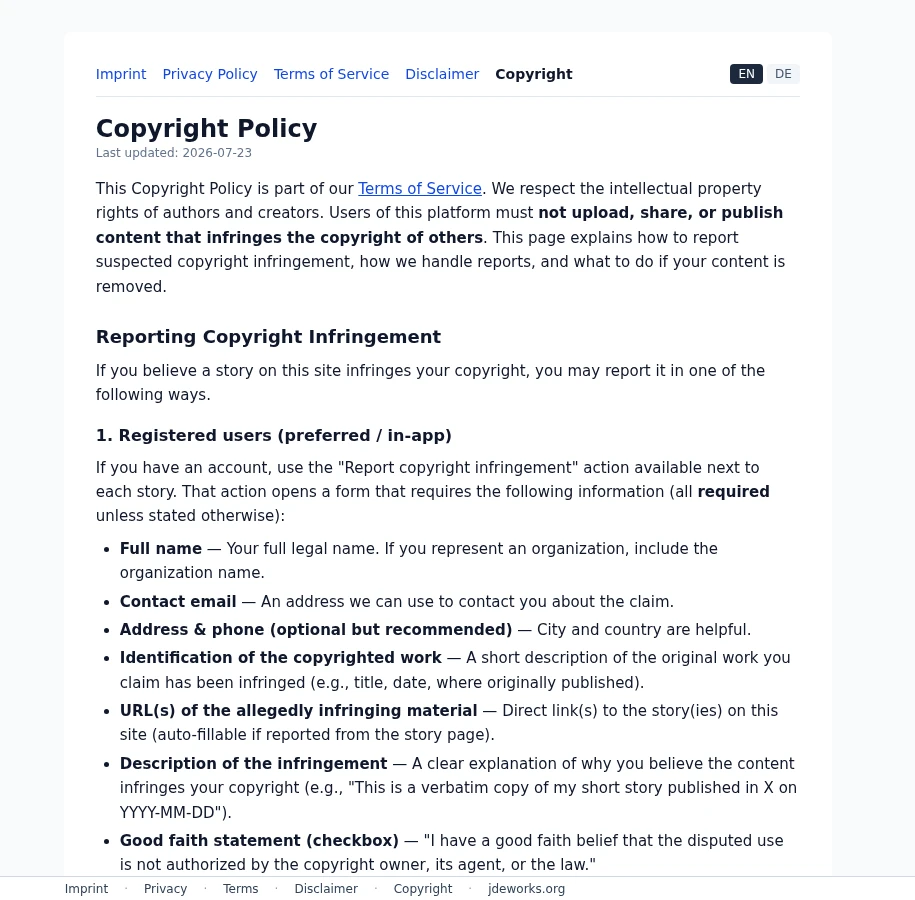
No account? The Copyright page in the footer lists an email route for non-registered rights holders and the exact information a mailed report needs.
What happens after a report
A filed claim takes effect immediately: the reported story is hidden from readers while the review runs, and its page shows DMCA Claim In process instead of the report button. Admins then review the claim, and the outcome goes both ways. A valid claim keeps the content down. A claim without merit gets the story restored and its author notified.Authors are not defenseless either. If your own story was hidden by a mistaken claim, the Copyright page describes the counter-notice you can send to get the removal reviewed.The formal policy, in English and German, always one footer click away.
Best practices
Publish your own worlds. Original stories are safe by construction and nobody can take them down.
Before importing an old text, check the author's death year against the 70-year rule, and remember translations have their own translators and their own clocks.
Copy the seeds' habit: when you publish a public-domain text, put the source in the story description.
File a copyright claim only for work you own or represent. False claims are made under penalty of perjury and the form says so.
Something offensive rather than stolen? That is a moderation case, handled through comments, ratings & reporting , not a copyright claim.
Sharing fan fiction? Put it in a fan-fiction group so it is marked, login-only and locked against continuations by default.
Under the hood
A copyright claim immediately sets a claim flag on the target. Claimed stories, characters and scenes disappear from search, discovery, overviews and reader pages until an admin resolves the claim.Claims are guarded server-side: they must contain supporting details, cannot target your own content, are rate-limited per account, and a target already under review is never double-claimed.The seeded classics live under dedicated public-domain author accounts whose display name is the real author. These accounts never log in and are excluded from public user statistics. Their Public domain chip and source link are distinct from the Generated collection label used for original AI-assisted stories.Seeded imports follow the German life-plus-70 rule and arrive private first, passing the same text moderation as user content before being switched public.Reports, claims and counter-notices are retained as the legal process requires. The authoritative wording, including the email route and the counter-notice contents, lives on the Copyright legal page in English and German.